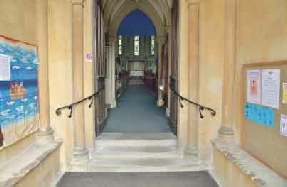
We have new, extended handrails on the exterior steps of the church, but many people will have wondered what happened to the interior set. It's a long story!
It all began many months ago when Tim Morgan, from Owlsorth, took on the task of replicating the original rails. The idea was to complement the style and form of the outer grab rails, thereby maintaining the historic integrity of the building. Alas, through no fault of Tim’s, the handrail company had moved premises and the intervening delays had caused the hold up in our rails.
As an interesting aside, the rails are now painted black but it is unlikely that they began life in that colour. Many people attribute the black painting of the railings to the demise of Prince Albert in 1861 and the subsequent queen’s preference for black: “paint everything black”. Alas, that is an urban myth; the church was completed during the reign of the ‘Sailor King’ William IV and the most common colour would have been grey. Grey paint was cheap, made of lead white mixed with lamp black and served to prevent rusting. It was not until the manufacture of Chrome Green in the 1820s that coloured railings became affordable. One of the earliest examples of this green was applied to the Duke of Wellington’s Apsely House railings, decorated during the 1820s. Therefore, our rails may have been in fashionable dark green - now there’s a thought!
The inner rails are completely new, there never having been rails there before. Take a close look at them when you next pass by and you will see that the handrail and scroll form has been maintained. As an aside, the church kept the cost down by ordering the inner rails with a single scroll to one end, but Tim thought that odd. In his own time and expense, he fabricated the second scroll for the other ends. Tim then considered the artwork for the brackets and again, took his cue from the church itself.
The shape of the wall fixing mimics the shape of the quatrefoil design on the doors. Even the bolt heads are in square form and indented to each side, perhaps in reference to the quatrefoil, symbolising the four evangelists.
The supports are hexagonal and tapered, again mimicking the original outer rails' support form. But stop to think again: that six-section symbolism recreates the six-pointed star sometimes called the Creator's Star, or Star of Creation. Its six points represent the six days of creation, and perhaps also the six attributes of God: power, wisdom, majesty, love, mercy and justice. None of the parts of these new rails can be bought ‘off the shelf’. Each and every item has been hand-wrought by Tim and their design is no happy accident; they hold within them the symbolism of the church itself. As a matter of interest, Tim is now working on a project for the Tower of London, supplying new handrails for the White Tower. When samples were requested they were sent a section of our rails and have elected to use the same form, as manufactured by Tim!
When you next pass by, stop and look closely at the work - you will be amazed.
Rod Trevaskus